
ROAM-AI ESP Optimization
Built by former operator data scientists and production engineers with deep experience in multi-basin unconventional operations.
3–8% Uplift. 40–50% Fewer Failures. 24x+ ROI.
ROAM-AI’s ESP Optimization solution continuously keeps wells in their optimal operating window by executing physics-constrained AI recommendations at machine speed. Operating limits are defined by pump curves, nodal analysis, inflow performance, and real-world constraints. ROAM-AI combines SaaS and wellhead hardware for granular pressure control and automated pump speed adjustment, extending run time and pump life, reducing LOE per BOE, improving production, and mitigating field risks.
Deployed across U.S. basins and leading producers, including 90% of ESP inventory at a $4B EV operator.
Top Benefits
Protect Deployed Capital
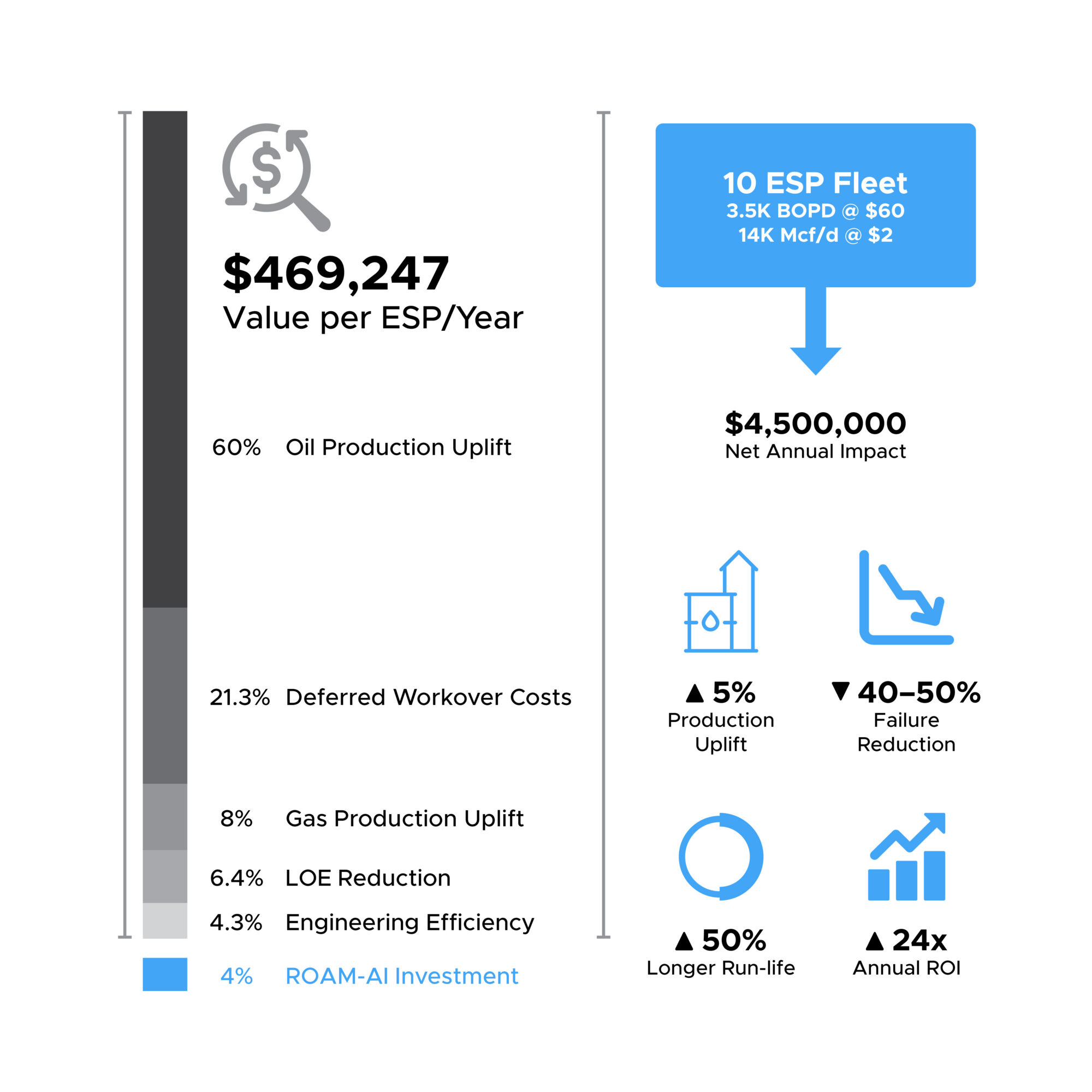
ROAM-AI delivers value across multiple economic levers at once. Production gains, lower failure-related costs, deferred capex, and reduced engineering load stack together to create measurable, repeatable impact at both the well and fleet level.
Eliminate Optimization Backlogs
ROAM-AI generates pump speed and tubing pressure recommendations with ML and executes in real-time with AI. With sub-second edge control, engineers guide a system that actively stabilizes intake pressure, mitigates gas interference, and smooths load and ramp profiles to extend runtime and reduce failures.
Operate by Exception
ROAM-AI reduces the cycle of trips, tweaks, and repeat failures. Instead of reacting to alarms and chasing issues across locations, crews operate in a more predictable, controlled environment with fewer interventions, improved safety, and more time focused on planned, higher-value work.
Measure Your ROI
Operators typically benefit from a 24x or more return on annual ROAM-AI investment, driven by production uplift, extended run life, and avoided failure costs. These distinct economic value layers compound across ESP fleets, paying long-term dividends from accelerated production and cash flow, avoided pulls/failures, LOE reduction, and increased engineering efficiency.
The following example illustrates where ROAM-AI’s ESP optimization solutions generate measurable value for a 10-ESP fleet using a production profile from the Delaware Basin (production uplift assumption is medium sensitivity; pull cost volatility, oil price, and adoption complexity are low).
For an in-depth breakdown of the economics and ROI estimates for larger ESP fleets, download our ROI Guide.
Two-parameter ESP Control
Adjust both pump speed and tubing pressure in real time through a combination of autonomous software and a patented valve controller (U.S. Patent No. 12,662,918).
Optimization Objectives
Target your specific business goals by optimizing ESP performance for maximum oil, gas oil ratio, minimum intake pressure, total fluids, or total economics.
Physics-Constrained AI Models
Trained on 400+ wells constrained by pump curves, nodal analysis, in flow, head depth (cannot recommend outside of physically feasible operating conditions).
Automated Gas Breakout Management
Continuously detects and responds to gas breakout conditions, stabilizes loading, and prevents damaging operating regimes before failures occur.
Open & Closed Loop Automation
At a glance, see AI recommended optimization opportunities, implement manually or scale to full auto-pumping with engineers in the loop.
Virtual Engineer
Get answers to complex questions about ESP performance, operating conditions, and well behavior, and instantly translate those insights into action and alerts.
Full Solution (Hardware + Software)
- Autonomous optimization with coordinated pump speed & tubing backpressure control at the edge.
- Stable pressure control to ±5 psi
- Auto‑restarts & fail‑safes
- Fewer field trips with on‑site autonomous valve/controller
Software-Only Solution.
- Cloud‑delivered optimization and recommendations
- Automated pump speed adjustment
- Field crews adjust valves/chokes manually
Included with Both Configurations
- Physics-constrained ML model trained on 5 + years of operating data
- Optimization opportunity tracking
- Real-time telemetry visualization, and contour-based optimization maps
- Virtual Engineer insights and alerts
Data Requirements
Production Stats
- Well Identifiers
- Surface Locations
- Produced Volumes
- Forecasted Volumes
Telemetry & Flowrates
- Amperage & Volts
- Setpoint Frequency
- Motor Speed
- Temperatures
- Pressures
- Flow Rates
Pump Models
- Name & ID
- Model & Package
SCADA Requirements
- Historian agnostic architecture
- Ingest from any existing historian, SCADA platform, or telemetry stream
- Lightweight historian option available
- Consume from third-party systems or displace them depending on operator preference
Available Set Points
- Tubing Pressure
- Drive Frequency
Failure Modes Monitored
- Gas interference instability
- ntake pressure excursions
- Load variance oscillations
- Suboptimal speed ramp profiles
Decision Space Constraints
- Manufacturer pump performance curves (multi-speed / multi-stage)
- Nodal analysis (IPR + tubing + surface backpressure)
- Inflow performance modeling (Vogel / modified Vogel)
- Head depth and intake pressure envelope protection
- Gas interference & GLR regime stability bands
- Variance minimization across intake pressure & motor load
- Root cause classification before prescriptive adjustment
Control Architecture
- Edge control loop latency: <100 ms
- Cloud inference & orchestration layer
- Guardrails enforced via physics-constrained operating envelopes
- Human-in-the-loop override always available
Success Stories
See how a Permian operator deployed ROAM-AI’s ESP optimization technology across 50 wells, increasing oil production by 3–8%, cutting downtime by 50%, and reducing G&A costs by $88,500.
Rob Hembree
Eric Warntjes
Are You Leaving Production on the Table?
Find Out in Less Than 60 Days
A structured 60-day pilot across a subset of your ESP fleet delivers real-time optimization, measurable production impact, and a clear path to full deployment without upfront risk. With discounted pricing, waived implementation, and rapid deployment available to your team, the only question is how much value you are leaving on the table by waiting.